Walls Have Lenses: The Quiet Legal Thicket of Recording Inside Your Own Home
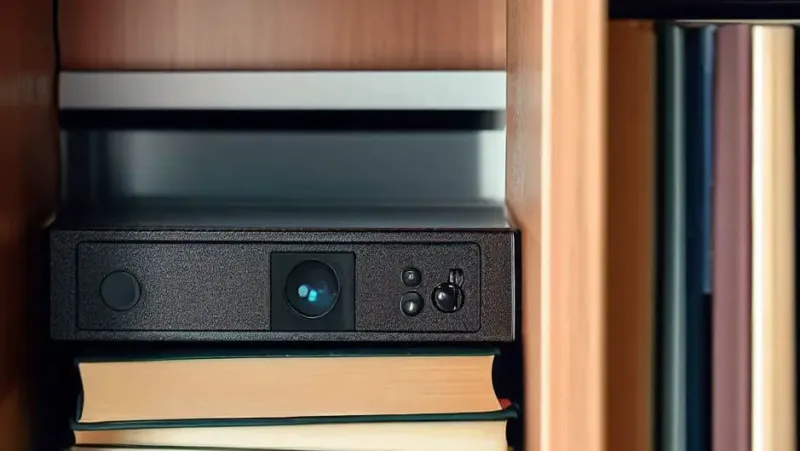
Photo: hidden home security camera on bookshelf living room, via safenow.org
A nursery monitor streams a sleeping infant to a parent's phone in another room. A clock radio in the living room quietly records a housecleaner's visits. A doorbell lens watches a dog walker come and go. Each of these scenes is ordinary in millions of American homes, and each one sits in a different place on the legal map — sometimes only a few miles apart.
In-home surveillance has become one of the fastest-growing corners of the consumer electronics market, yet the rules governing it remain a patchwork that surprises even careful homeowners. The assumption that your property equals your rules is only half true, and the half that's wrong can carry real consequences.
The Core Distinction: Audio Is Not Video
The single most important dividing line in United States surveillance law is the one between what a camera sees and what it hears. Video recording in your own home — in areas where residents and workers have no reasonable expectation of privacy, such as living rooms, kitchens, and entryways — is broadly legal in every state.
Audio is another matter entirely.
Federal law sets a floor through the Electronic Communications Privacy Act, but most states have layered their own wiretapping statutes on top, and they split into two camps. Roughly a dozen states — including California, Florida, Illinois, Maryland, Massachusetts, Pennsylvania, and Washington — operate under what is commonly called two-party or all-party consent. In these jurisdictions, recording a conversation generally requires the agreement of everyone taking part. A nanny cam with a live microphone that captures a babysitter's phone call, or even her side of a casual chat with a colleague, can run afoul of these statutes.
The remaining states follow a one-party consent model, under which a recording is lawful if at least one participant — in a home setting, typically the homeowner — consents. But even here, courts have carved out exceptions, and civil liability can attach in situations where criminal prosecution does not.
The practical takeaway is blunt: a camera that records sound is a categorically riskier device than one that records images alone, and many homeowners do not realize their baby monitor or indoor security camera is capturing audio by default.
Where the Camera May Not Look at All
Even in one-party consent states, location matters. Bedrooms and bathrooms occupied by household employees, guests, or tenants are treated very differently than shared spaces. A hidden camera in a live-in nanny's bedroom or a guest bathroom can trigger criminal exposure regardless of the state, and several states have enacted specific statutes banning nonconsensual recording in places where people undress or sleep.
Landlords face an additional layer of restriction. Installing cameras in a rental unit's private areas — even ones the landlord owns — has generated enforcement actions and civil suits in multiple states, and lease clauses purporting to authorize such monitoring are frequently unenforceable.
When Your Footage Becomes Someone Else's Evidence
Homeowners rarely think about discovery — the legal process by which opposing parties in litigation can demand relevant records. Yet home surveillance footage is discoverable, and it has appeared in a striking range of American courtrooms: custody disputes, personal injury claims, employment disagreements with domestic workers, and insurance litigation.
A custody battle is the classic example. Family court judges routinely admit nanny cam footage, and a recording made to protect a child can just as easily document a parent's own questionable conduct. Once a camera is running, its archive belongs as much to the future as to the present.
The Breach Nobody Planned For
Then there is the problem of where the footage lives. The majority of consumer cameras sold in the United States stream through manufacturer cloud services, which means the most intimate recordings inside a household are stored on remote servers, protected by whatever password hygiene the owner practices.
Security researchers have documented years of weaknesses in this ecosystem: default credentials that owners never change, unpatched firmware, credential-stuffing attacks using passwords recycled from breached websites, and in some documented cases, strangers accessing live nursery feeds. The Federal Trade Commission has brought enforcement actions against camera manufacturers over inadequate security practices, and class-action litigation over compromised home cameras has become a recurring feature of the docket.
The privacy irony is sharp. A device installed to reduce uncertainty about the people inside your home can become the very channel through which outsiders observe your household.
What Responsible Monitoring Looks Like
Security professionals who work with families and domestic employers tend to converge on a short list of practices:
- Disclose. Telling a babysitter, cleaner, or contractor that cameras are present is not only the ethical baseline; in some employment contexts it aligns with state workplace notification requirements, and it eliminates the consent problem for audio entirely.
- Disable the microphone unless there is a specific, documented safety reason for it. Most consumer cameras allow audio to be turned off in settings.
- Avoid private zones absolutely. Bathrooms, guest bedrooms, and changing areas are non-negotiable.
- Harden the account. Unique passwords, two-factor authentication, and prompt firmware updates address the majority of remote-access attacks.
- Prefer local storage where feasible. A camera that records to a local drive keeps footage out of third-party clouds, shrinking both the breach surface and the third-party data trail.
- Retain deliberately. Automatic deletion after a short retention window limits what a subpoena, a breach, or a lawsuit can reach.
A Household Policy, Not Just a Purchase
The camera industry sells reassurance, but surveillance inside the home is ultimately a governance question. Every household that installs one is making decisions about consent, employment, data storage, and legal exposure — usually without writing any of them down.
The families that fare best, both ethically and legally, are the ones that treat monitoring the way a small business treats compliance: transparent with the people affected, minimal in what is collected, and deliberate about where it is kept. The lens on the wall is the easy part. The policy behind it is what actually protects everyone inside those walls.