Trust at Group Velocity: How Scammers Learned to Speak Fluent Family
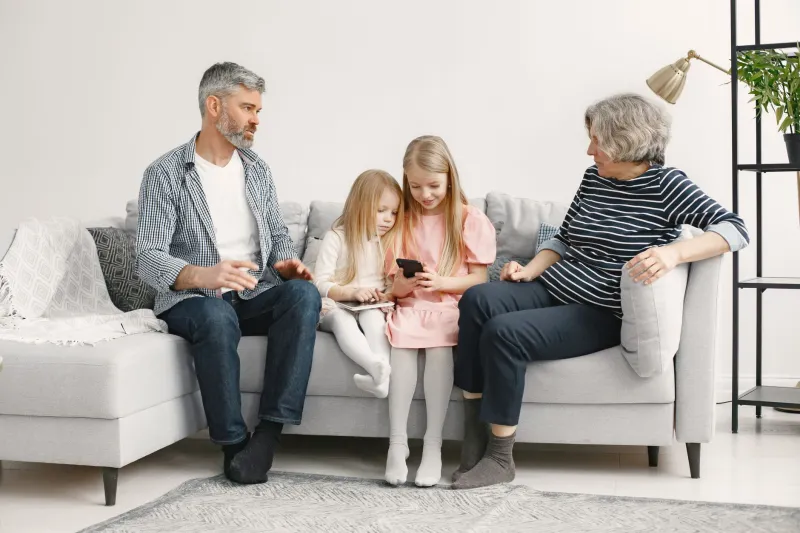
Every family group chat in America has its own gravity. The one where your uncle forwards weather warnings, your cousin posts airport updates, and someone's mother sends a Good Morning America link with seventeen exclamation points. These threads feel like the digital equivalent of a kitchen table — a place where nobody checks credentials before speaking.
That warmth is exactly what makes them a target. Over the past two years, security researchers and consumer-protection agencies have watched a steady migration in scam tactics: away from cold outreach and toward warm spaces. The group chat, with its built-in roster of trusting relatives, has quietly become one of the softest perimeters in American digital life.
The Perimeter Nobody Guards
For decades, security advice has focused on the boundary — the firewall, the email filter, the spam folder. We treat strangers as the threat and familiars as safe. Group chats invert that model entirely. A single compromised account — a sibling's phone number ported by a SIM-swap, a parent's login lifted from a credential-stuffing attack — converts an outsider into a trusted voice with one tap.
From there, the attacker doesn't need to be clever, only believable. The fake emergency is the classic: a hijacked account claiming a stranded traveler needs money wired, or a 'quick favor' involving gift cards. In these scenarios, urgency does the heavy lifting. The scammer knows that a panicked relative asking for help rarely gets scrutinized — because in a family, asking for help is normal.
Why We Stop Thinking at the Kitchen Table
The psychology here is well documented. Researchers who study trust call it the 'familiarity heuristic': when a message arrives in a context we associate with safety, our analytical guardrails drop. Nobody suspects Grandma of phishing. And crucially, group chats carry social pressure that one-on-one conversations don't — if everyone else replies with heart emojis, being the one to ask 'wait, is this really you?' feels rude, even paranoid.
There's also a structural problem. Group chats blend content types constantly: a recipe, a medical update, a link to a local news story. Because links are ordinary in these spaces, a malicious one doesn't stand out the way it would in a cold email. The malicious link doesn't arrive looking suspicious. It arrives looking like Tuesday.
The Anatomy of a Chat Takeover
Most family-chat compromises trace back to one of three entry points. The first is account takeover through reused passwords — an old breach gives an attacker access to a messaging account, and the chat becomes a ready-made distribution list. The second is SIM swapping, where a phone number is redirected to an attacker's device, capturing verification codes and hijacking the identity that the number represents. The third is simpler still: a malicious link clicked on one device that harvests session tokens or spreads itself onward, turning each recipient into the next sender.
What all three share is that the group chat is rarely the initial target. It's the multiplier. The attacker compromises one person and inherits the trust of twenty.
Verification Without Paranoia
The good news is that defending a family chat doesn't require turning it into a security operations center. It requires agreeing — in advance, calmly — on a few shared habits.
Establish a family code word. This sounds almost quaint, but it works. A phrase agreed upon offline, used only to confirm genuine emergencies, gives every member an instant verification tool when a message asks for money or urgent action. If the sender can't produce the code word, the emergency isn't real.
Change the channel for money. Make it a household rule: any request involving payment, wire transfers, or gift cards gets confirmed through a second channel — a phone call to a known number, a face-to-face conversation. The request itself can be legitimate; the confirmation just doesn't happen in the same thread.
Treat links in chat the way you'd treat links in email. Hover before tapping, look at the actual domain, and be wary of shortened URLs. In a family chat, the person who pauses to check isn't being rude — they're doing what no one else realizes needs doing.
Lock down the accounts behind the chat. Since most compromises begin elsewhere, the real perimeter is each member's email and messaging account. Strong, unique passwords and app-based or hardware-key two-factor authentication make the hijack dramatically harder. A password manager takes most of the friction out of this for less technical relatives.
Give everyone permission to be skeptical. The most powerful cultural change a family can make is normalizing the verification question. If the standing joke is 'Mom always calls to confirm before sending money,' scammers lose their most valuable asset: the assumption that verification never happens.
A Perimeter You Can Actually Maintain
Security professionals have long noted that the strongest systems aren't the ones nobody attacks — they're the ones where trust is verified rather than assumed. Family group chats won't stop being warm, chaotic, and full of forwarded nonsense, and they shouldn't be. The goal isn't suspicion; it's a shared understanding that in this space, like everywhere else online, identity is something we confirm, not something we inherit.
The kitchen table survived decades of door-to-door scammers not because families stopped being trusting, but because they learned which knock to answer. The group chat deserves the same education — delivered with the same calm.